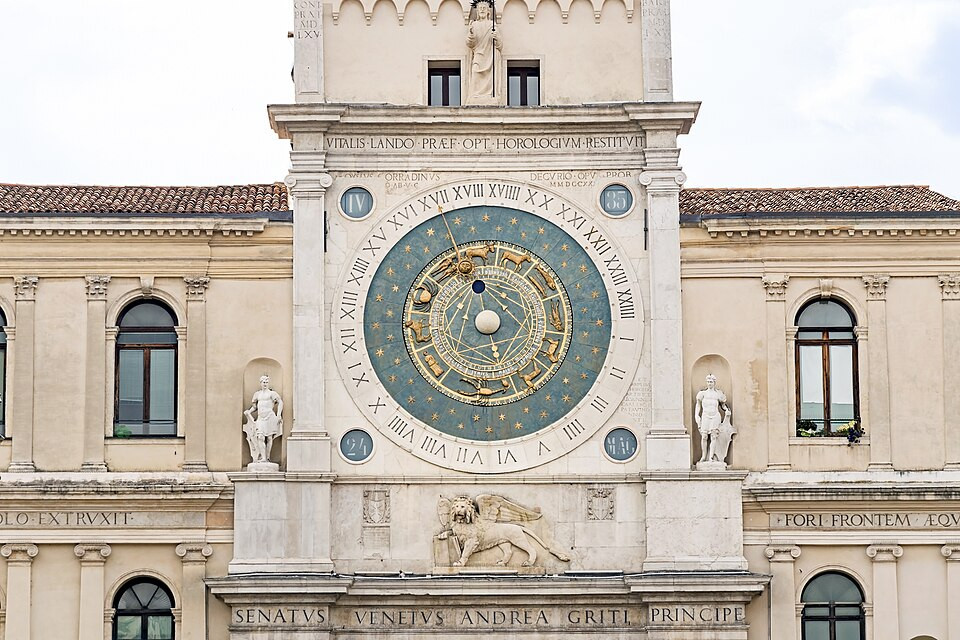
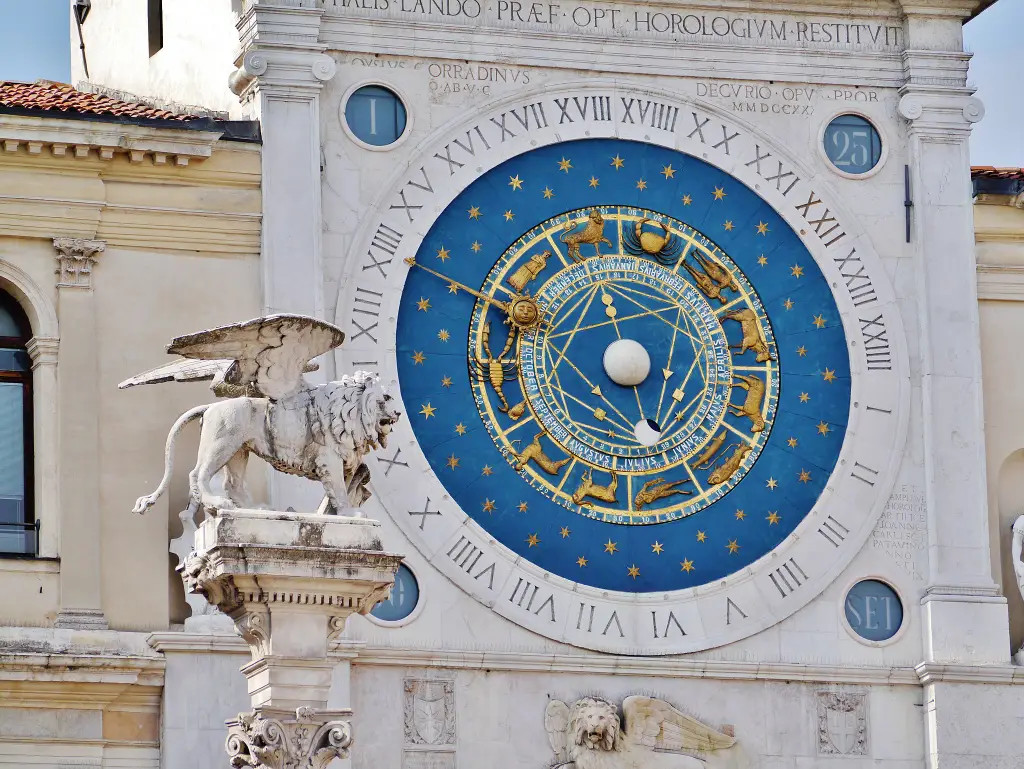
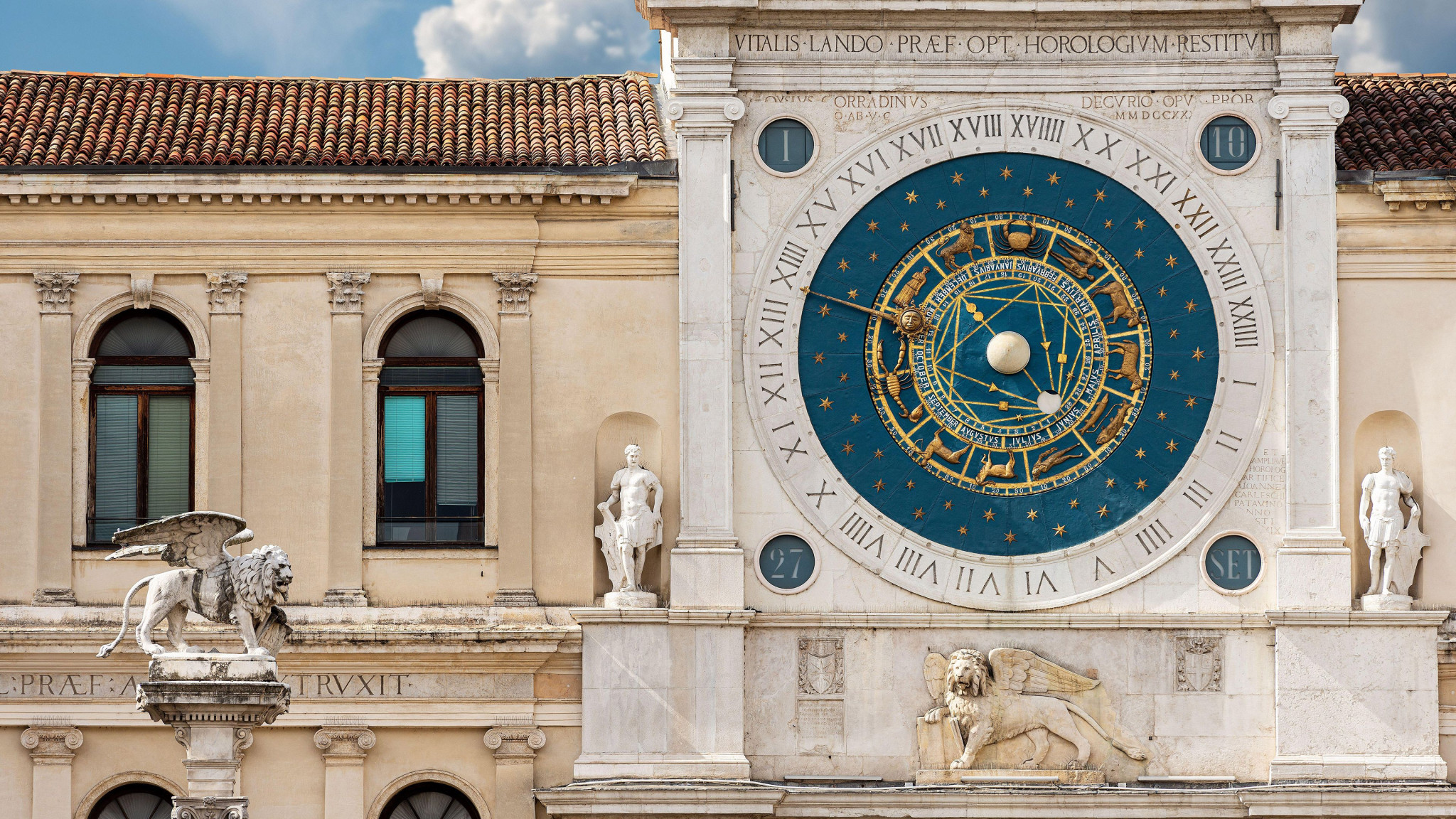
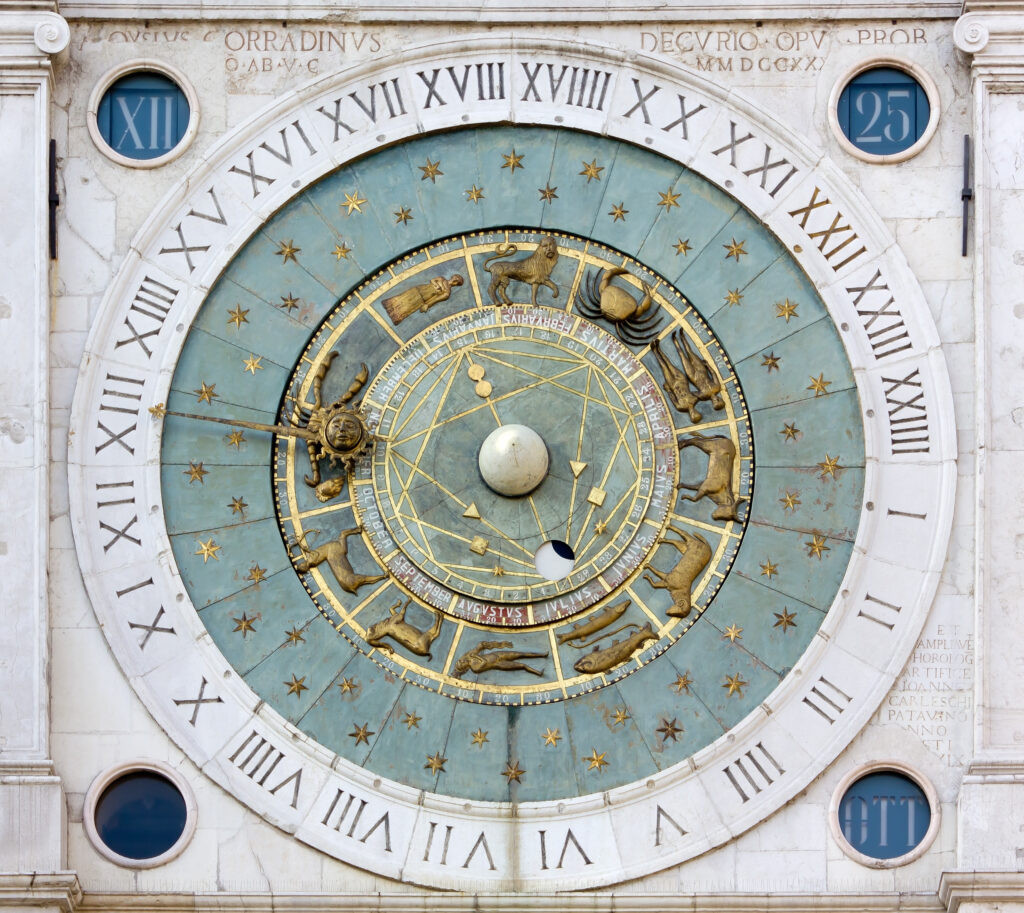
Shown here is the famous 15th-century Padua tower clock (click on an image to view it at full size). It replaced the original astronomical clock, designed by Jacopo Dondi, that was installed in the tower in 1344, which was unfortunately destroyed in 1390 when Milanese and Venetian soldiers stormed Padua. Now under Venetian rule, the clock tower was reconstructed again in 1428, and a new astronomical clock, following closely upon the design of the original one, was built by Novello Dondi, a descendant of Jacopo, and inaugurated in 1437.
This 590-year-old clock has a number of interesting peculiarities, such as:
(i) Jacopo's design was based on the Ptolemaic notion that the Earth stands at the centre of the Universe. Accordingly, the white disk representing Earth stands exactly at the centre of the dial, surrounded by the Zodiac constellations, and an outermost circle of stars.
(ii) The small aperture within the innermost dial shows the current lunar phase.
(iii) The clock has a 24-hour dial, a system of timekeeping that was popular in Italy during the 14th and 15th centuries. Additionally, the clock does not have a minute hand, but only an hour hand that completes one full revolution per day. At midnight the hour hand points straight to the right, at six o'clock in the morning precisely, the hour hand points vertically downwards, at noon precisely, the hour hand points horizontally towards the left, whilst at six o'clock in the evening precisely, the hour hand points vertically upwards. The hours are represented in Roman numerals, and underneath each hour is a circular depression, which signifies the half-hour. Each hour is enclosed in a dial segment, with the segment's right edge signifying the completion of the previous hour.
(iv) There is a circular aperture at each of the four corners of the dial. Starting from the upper left aperture and moving clockwise, these apertures mark the present hour, minute, month, and day. The month is represented by the first three alphabetical letters of its Italian name, whilst the minute and calendar date are represented by Arabic numerals. The hour is represented by Roman numerals, using the 12-hour format. Interestingly, the aperture represents four o'clock as "IV", but in the dial itself four is always represented as 'IIII'.